Zebec and the Money You Have Already Earned

It's the nineteenth of the month and there is money you have earned that you cannot touch.
Not money you're owed for future work. Money for hours already worked, sitting in a company's account, accruing quietly to you and unavailable until a date somebody picked. Rent is due on the first. The car needs fixing on the twelfth. And so millions of people borrow at brutal rates against wages they've already banked, because the wages exist and the access does not.

The gap between doing the work and holding the pay is one of the most expensive empty spaces in modern finance, and almost nobody talks about it, because it feels like weather.
The pay cycle was a decision
It wasn't weather. It was a choice, made for a machine that no longer exists.
The two-week pay period comes from paper. Someone had to collect the timesheets, run the numbers by hand, cut the cheques, and post them. Doing that daily was impossible, so payroll became a batch job, and batch became the rhythm of working life. The computers arrived, then the networks, then instant settlement, and the rhythm never changed. ACH still moves in scheduled batches. Money that could travel in a second travels on a calendar.
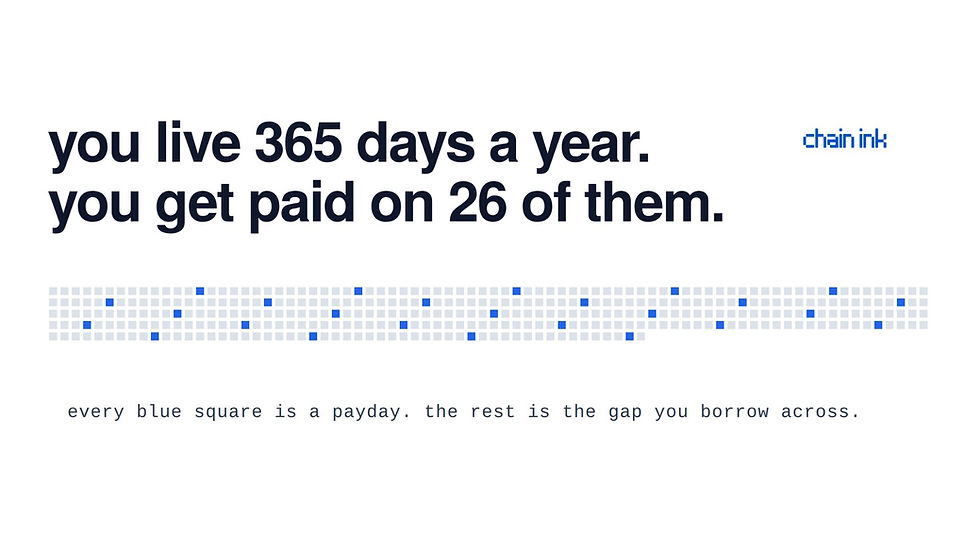
There's also a quieter reason it stayed. The delay is worth something to whoever is holding the money. Wages sitting in a company account for two weeks are wages earning interest for somebody who is not you.
And here's the part that explains why this hasn't been fixed already. The person who feels the pain doesn't choose the system. Payroll software is sold to employers, and for an employer the current arrangement works fine. So the obvious better version has sat there for a decade, technically possible and commercially unsponsored.
Which leaves a question nobody with the power to answer it has been in a hurry to ask. If work happens continuously, why does the money arrive in lumps?
Money as a stream
Zebec's answer is to stop treating a payment as an event.
The idea is simple enough to explain in one line. Instead of sending a lump sum on a date, you open a stream, and the money moves continuously from one account to another, second by second, for as long as the work continues. An hour worked is an hour paid. Stop the stream and the payments stop with it. There's no cheque, no run, no cut-off date, because there is no batch to cut off.

That changes what a salary is. It stops being a promise settled fortnightly and becomes a balance that grows while you work, available the moment it exists. The same mechanism handles anything else that accrues over time rather than all at once, rent, subscriptions, vesting, a contractor's invoice. Billing periods exist because the old rails couldn't do the other thing.
Underneath, Zebec runs its own chain for this, tuned for many small continuous transfers rather than occasional large ones, which is a genuinely different engineering problem. A stream is thousands of tiny payments where a payroll run is one big one. A salary that exists only on payday is a promise. A salary that accrues by the second is money.
It went and got the plumbing
Here's where Zebec stops looking like a crypto protocol and starts looking like something more awkward and more interesting.
Streaming money isn't hard to demo. The hard part is that payroll touches tax, identity, banking rails, and regulators, and a smart contract satisfies none of them. So Zebec spent its years buying and building the boring half.
It joined Nacha's Payments Innovation Alliance in December 2025, the body that governs the rules of the $85 trillion US ACH network, sitting alongside members like JPMorgan, Wells Fargo, and ADP. It achieved ISO 20022 compliance, the messaging standard SWIFT and central banks run on, which is what lets a crypto system talk to a bank system without a translator in the middle. It acquired NatPay for traditional payroll infrastructure and Gatenox for native identity checks. It issues a debit card so streamed wages can be spent without touching an exchange. It was picked to build native payroll on Stellar, and it turned up on Circle's institutional testnet next to Visa, State Street, and Mastercard. With Lattice it launched a Mastercard debit card on the Canton network, the settlement infrastructure Goldman and DTCC use.
That's a specific and unfashionable bet. Not that payroll will move on-chain because on-chain is better, but that it will move only once the on-chain version can pass an audit, file the right messages, and check the right identities. The technology was never the obstacle. The paperwork was.
The bet
Be honest about where this sits, because the rails are real and the proof is thin.
ZBCN trades near two tenths of a cent, a market capitalization around $200 million, roughly seventy percent below its May 2025 high. The token supply is fully in circulation after the final unlock, so there's no overhang waiting to land, and the model shifts to buybacks funded by revenue, which only works at the size of the revenue funding it.
The company reports more than $500 million in annual payroll volume across 250-plus enterprise clients.

Treat those as company figures, because they are, and note what's missing around them. Adoption metrics aren't published in any form an outsider can verify. There's no public dashboard showing streams opened, cards spent, or wages actually flowing. For a protocol whose entire thesis is volume, that absence is the number.
And the structural problem hasn't gone away. The buyer of payroll software is the employer, and the employer is the one party the current system already suits. Zebec has to sell a fix to people who don't have the problem. Streaming payments aren't proprietary either, with Superfluid and Sablier offering the same primitive, so the moat is the compliance stack rather than the technology.
A long list of things still has to go right. The partnerships have to become volume rather than press releases. The superapp has to convert institutional groundwork into people actually getting paid this way. And revenue has to reach a size where buybacks matter. None of that is priced in today. That's the risk and the opportunity wearing the same coat.
The money you already earned
The deepest habits in finance are the ones nobody remembers choosing. We accepted that money arrives on dates, that access lags work by days or weeks, that the space between the two is just how it is, and an entire lending industry grew inside that space, charging people to borrow their own wages back.
Zebec is betting the pay cycle is the last piece of finance still keeping time by a machine that stopped existing decades ago. Whether it wins is an open question, and the market has clearly not decided that it has.
But the idea underneath is hard to argue with once you see it plainly. You already did the work. The money is already yours. The only thing standing between you and it is a date somebody picked.


Comments